Oh wow. Almost 2 year hiatus. And the thing that brought me back was a film about memory, mourning, humanity, relationships. So really, re-reading the last and inaugural post, it’s like I never left.
After Yang is a film by the mononymous Kogonada. In a soothing, dreamy, A24-stylized near-future where, for all intents and purposes we have somehow avoided climate catastrophe but not sinophobia, a family contends with the malfunction of the “techno sapian” they purchased. Yang (Justin H. Min), bought second-hand, is brought into the home of Jake (Colin Farrell) and Kyra (Jodie Turner-Smith) as a sort of cultural companion to their adopted Chinese daughter, Mika (Malea Emma Tjandrawidjaja).
As the family attempts to fix Yang, or face the loss of his presence in their lives, like in any speculative fiction treatment of the “do androids dream of electric sheep” trope, reflections and refractions on what it means to be a human emerge. Other technological concerns – privacy, surveillance, labour, connection, the material world – are gently pulled along in the wake of this central consideration, like churned seafoam before it’s blown away by the wind.

In the process of attempting to repair Yang, Jake gains access to Yang’s heretofore unknown-of memory bank. The memory bank is accessed through a special set of glasses, and the memory fragments (at a maximum of 3-4 seconds in length) appear like points in a neural network, or stars in a galaxy. With the glasses, Jake is able to play and replay these snippets and through them, experience Yang’s sense of self and humanity, connecting to his own life through the gaze and record of an android.
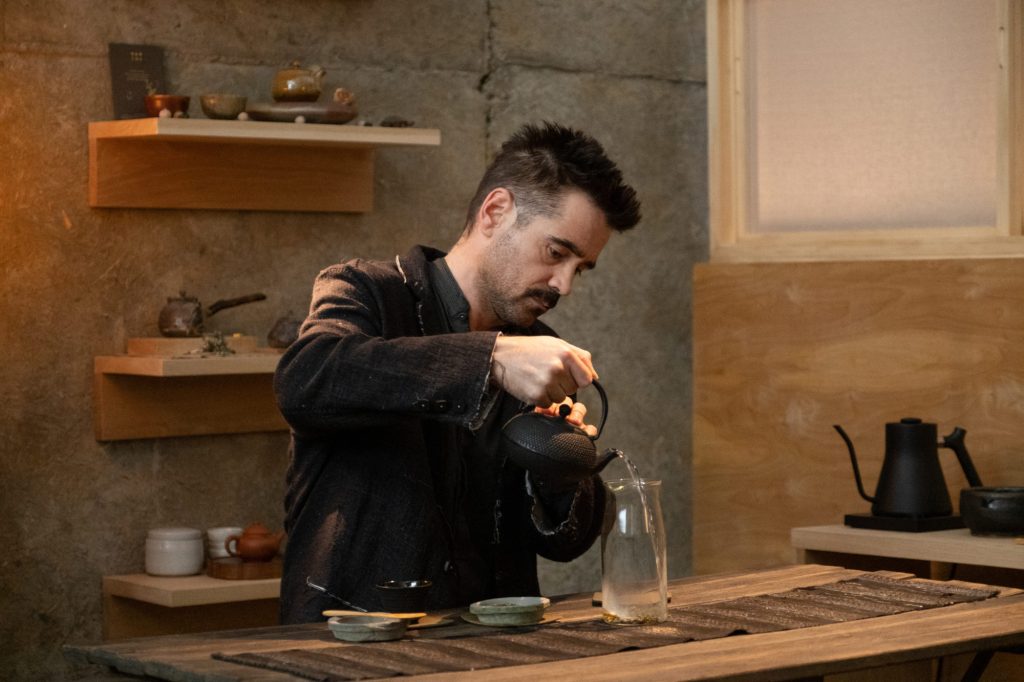
This is a film that is muted, subdued, hushed. Big questions and ideas packaged in restrained furoshiki. The interiors are all testaments to Japandi minimalism, made warm with wood and plants. The cars are self-driving, frictionless pods gliding through tunnels, but also feature soft, living grasses and greenery. I can’t talk about this film without mentioning the sound design. Voices are limpid and full and rich, like a mug of steamed cream poured viscous into your ears. Yang’s memory clips are repeated, sometimes in sequence, sometimes revisited in subsequent scenes. Lines of dialogue are also treated similarly. The Jake character is an aesthete, he wears haori-like chore coats and runs a tea shop (this resonated with me, obviously!), brewing specialty teas. The ceremony and attention he brings to his tea is lovingly depicted, the sound of the hot water pouring into the pot, the clink of the china, all recorded to give the impression that you are in the room with Jake, your senses attuned to the present to a pitched up degree we can rarely approximate in our humdrum lives. All of this attention, even while Jake seems removed and disconnected from his wife, his daughter, and in many aspects, his life.

The theme of fragmentation runs throughout this movie. Yang’s memories (a red maple quivering, Mika running, a recurring girl turning to him at a concert while a Mitski song plays hauntingly in the background, Yang regarding himself in the mirror, Jake and Kyra sharing a tender, quotidian moment on the couch) are disjointed, in the same way that for living, breathing humans in the world, our recollections are spliced into little moments. When I reflect back on a day, a week, a year, decades, what my mind pulls are flashes, and from all those bits, a perspective, a way of seeing/being is constructed. I can’t reflect on this without also thinking about how our much-maligned social media habits are really an extension of this. Stories, tweets, grids – splinters of moments that when pieced together make a verifiable version of a person’s personhood, but is this version any more/less than our memories’ accounting of our lives?
The Mitski song in question is also cleverly layered. It is a cover of “Glide” – a song attributed to Lily Chou-Chou that appeared on the soundtrack for the film All About Lily Chou-Chou. Lily Chou-Chou itself was a fictional band – so you have Mitski making something real out of something that was approximating something real. This play on signification and re-presentation is enough to make me a Kogonada fanboy for life.

Kogonada is a deeply intentional filmmaker (she says, from her first encounter with his work). The form of the film mirrors the ideas it invokes. You can’t think about fragmented memories without thinking about the life that exists betwixt and between them – like the scenes we don’t see on screen, the things left unsaid, the negative space that hints at the positive. It is only when the family loses Yang that they see him and are prompted to re-form around the vacuum his absence creates. From his “death” life is made. At one point in the film, a past interaction between Kyra and Yang is shown, in which Kyra muses on death. Yang responds (my cursory research revealing that this quote is attributed to Lao Tzu, though perhaps incorrectly) “What the caterpillar calls the end, the rest of the world calls a butterfly.” Later, we discover Yang has other cached memories from previous lives he’s lived, and we see the thread running through them.
Ruminating on how a person should be, what makes a life, what is death, what is meaningful, what lasts, what is fleeting, have been preoccupations of mine, of late (maybe always?). You know, the idle chit chat considerations, no big deal. How to be present in this life, how to move through the mundanity, what are the stories we tell ourselves and about each other, and on and on times infinity. A global pandemic that restructures our social relations, alongside middle age, children getting older, death, pain, sadness, a thinking brain and a tender heart will engender that kind of thing. Balancing noticing and attention, with appreciation for each moment and breath we get, and understanding that momentary fragments of beauty – all the love we have in our bruised hearts crystalized down into a piercing shard – amid all the forgettable or banal or trying moments, is enough, because it’s all we have. That’s what living is.
 chinottoismynemesis